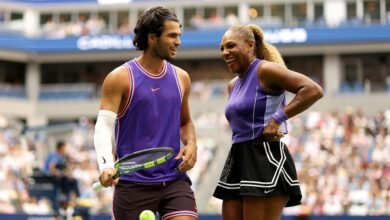

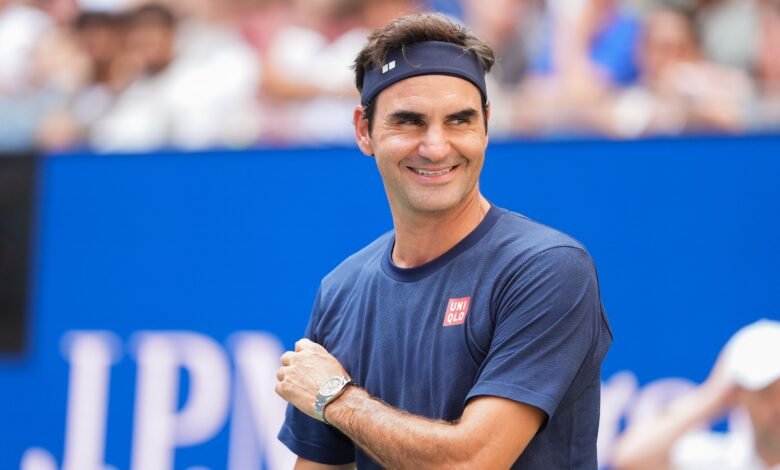
When I roll up to the flagship of On, the Swiss shoe company, in Manhattan’s Flatiron neighborhood, I find scores of schoolkids queued up outside. Many are holding tennis rackets and tennis balls with the dream of having them signed by the man many call the greatest to ever play the game: Roger Federer. The newest inductee to the International Tennis Hall of Fame (alongside broadcaster Mary Carillo)—the festivities are this coming weekend in Newport, Rhode Island—he has been all over New York in the last few days, launching a limited-edition version of On’s The Roger shoe (with a grass-colored sockliner and some intriguing Easter eggs that we’ll let you discover on your own) and attracting another huge throng of fans yesterday at Arthur Ashe Stadium, merely to witness him warming up on the court with Lorenzo Musetti.
Inside the store, I find Roger chatting with his longtime agent and manager, Tony Godsick, and we sit down amid the chaos—plans were underway for Roger to hang out with the kids, answer questions, and to play some ping-pong with them—for an easygoing chat about his Hall of Fame induction, his own estimation of his legendary career, the state of tennis today, and his eagerly anticipated exhibition match (tonight out at Ashe Stadium) against Andy Roddick in singles, and against Roddick and Andre Agassi in doubles, with John McEnroe as Roger’s partner.
Vogue: Before we get into the Hall of Fame and talk about the exhibition, I wanted to ask you about your so-called retirement. Do you feel retired? Is your life different now? You seem pretty busy to me. Roger Federer: I definitely feel retired, definitely feel very different. Maybe the first year or so was an unwinding year, just getting used to the new rhythm and learning how to fill up your day—how much travel are we doing, how is it with the kids now?
Things were going from one to the other
But things were going from one to the other quite smoothly, and so overall that transition was rather easy. Now, maybe for the last year and a half, two years, I feel like I’m really in control of my new life—and it’s been great. Last year we traveled a bunch with the children, too—we always try to stay together. At the same time, I work really hard and I like being active and busy.
Do you have new hobbies or directions your life has taken, or is it more about traveling with the family? Family will always be a big deal, but especially so now—the boys are 12, the girls are 17, so we’re right in the middle of supporting them with school and their after-school activities, so it’s nice not to have a next match coming or a next practice coming, where mentally maybe you’re always a little bit distracted.
I was extremely good at balancing that part, but it’s just nice not to have that. I also have more time to think more creatively, with Tony [agent and manager Tony Godsick] and Mirka [Federer’s wife] and the team, of what we could do together with the brands I work with, or just in general with travels and having fun—where could I go play golf, and how is tennis looking, and what’s the landscape there?
I’m also not saying yes to everything—I’m protecting
I’m also not saying yes to everything—I’m protecting myself and trying to be very selective. We’re in the midst of a bit of Roger-mania. Tonight you’re playing an exhibition with Andy Roddick in singles and then partnering with John McEnroe out at the US Open site. How did all this come about? I’ve been very careful to not come back to every important place to me right away.
I’ve done Wimbledon every year; because that place was so important for me I wanted to just rip the Band-Aid off and do that. Australia’s far away, so I couldn’t do that every year, but I went this year and played exhibition doubles and they honored me for, I guess, all the matches and all the emotions we’ve created there over the years. As for the French Open—I was only there for Rafa’s farewell, when he retired.
But I never really had a chance to really say goodbye to New York, because I actually retired after the US Open, in London [at the Laver Cup]. So for me, this is all a way to say goodbye to the New Yorkers, and to Flushing Meadows, a place where I loved playing—and to do that in combination with Newport, Rhode Island, with my Hall of Fame induction, which is on Saturday, is a nice story for me.
It allows me to incorporate everything together
It allows me to incorporate everything together. I think it’s also a nice story for the game. And then I return on Monday for the ring ceremony—it’s when I get the ring for the induction on the court at Arthur Ashe. So it’s going to be cool. The pairing of you with Johnny Mac for doubles tonight seems…inspired. [Laughing.] Yeah, definitely. We’ll see how it’s going to go.
I’ve never played with him, so yes, I was very excited when I heard that he could do it. I mean, he’s from here, and he’s a legend—Johnny has done so much for the game in terms of playing, of course, but also especially his commentating. And if I look at the other guys playing, it’s different generations—with Roddick and Agassi. And I’ve played Roddick both here in the finals and many times on the tour.
But I’m very excited to play. Let’s get into the Hall of Fame honors a bit. Obviously your achievements, your contributions to the game are massive—but is there one thing, whether it’s a tiny technical thing or a huge philosophical thing or something in between, that you’re most proud of? Honestly, this is my first real interview on the eve of the Hall of Fame, and I think I have to start thinking about what has actually happened, and what I am most proud of, and what’s been the most special of memories.
There’s got to be something that surrounds Wimbledon—I
There’s got to be something that surrounds Wimbledon—I think my eight wins at Wimbledon really changed my life and made me very happy—and also the five wins in a row here [at the US Open] from 2004 to 2008 was an incredible time. And a lot of them were in combination—winning Wimbledon and then winning the US Open—and having done that, I think, is one of my proudest achievements.
That I was able to have my game evolve over the years to become the player that I became—I would have never thought I was going to be this successful, ever, to be quite honest. I come from humble beginnings, and sure, I was talented, but I never really knew how far it was going to take me. You reach a lot of crossroads in your life, and you have to make the right decisions and be able to persevere, and I’m very proud of the fact that I was able to do that.
And hopefully I represented the game well—it always made me happy when parents or kids would come up to me and tell me I’m their favorite player, or a good role model. On the other side of this coin: Is there anything—a match that you lost, or even one single shot—that you still think about in terms of something left out on the court, or a missed opportunity? Of course you have some minor regrets where you’re like, I wish I could play that shot again, or I wish I could play that match again.
Two of them are actually linked
Two of them are actually linked to the US Open and to Wimbledon, because they broke my streak of five in a row. Here was against [Juan Martin] del Potro in ’09, and at Wimbledon it was against Rafa—obviously the epic one in ’08 [when Rafael Nadal beat Federer in what some call the greatest tennis match of all time]. Winning those matches would have kept my streak [of consecutive titles] alive—I could have gone to six, or who knows, seven, because I won Wimbledon the following year again, and then again in ’09 against Roddick.
So yeah, you have moments like these where you’re like, what a shame, because you just know in that moment when the streak snaps that you’ll never get to another five in a row—it’s just not going to happen. So it feels a bit disappointing and a bit bitter, but in the end, all good. It’s part of the game and I’m happy I don’t carry those losses with me today—I really have focused heavily on the good moments.
In terms of your shot-making and your form, you’re often admired for your grace and elegance on the court. Was it a conscious thing to play this way, or is it something that was taught to you? You once credited Peter Carter, your instrumental coach, for “your entire technique and coolness.”
I modeled my game on the ’80s and ’90s, when a lot of guys, including [Boris] Becker and [Stefan] Edberg and [Pete] Sampras, had one-handed backhands and a lot of the coaches then were one-handed players—including Pete Carter, who was Aussie, and famous for slicing, coming to the net, playing very aggressive tennis with beautiful volleys.
If your coach plays like this, you mimic
If your coach plays like this, you mimic them. But also, the grips were not so extreme yet because we were still playing with smaller racket sizes, and didn’t have the crazy synthetic strings we have now, so we had to be a little bit more controlled in the swing. So that’s number one. Number two, as I grew older and I was transitioning from the ’80s to the ’90s, I had to start learning how to create extra topspin and extra grip on the ball—and this is where, I guess, the cool factor came to it, but it wasn’t just about being elegant and pretty.
It became quite aggressive tennis. And then, of course, sometimes you have a certain way you’d like to play: You watch yourself on TV and go, Oh, that didn’t look like how I actually felt it—it looks terrible, but it feels good. You start to make your game look different and feel different, and while it’s always based on the results, I guess I was pretty fortunate that just my game ended up looking the way it did.
I don’t think my goal was to be a pretty tennis player. In the standard bio of Roger Federer, there’s this period when you’re young, you’re a teenager, you’re new to being a pro player—and you’re not the Roger that we all know. You are volatile, you have a temper, you’re mouthing off and throwing rackets. And then in the standard bio, you magically transform into the preternaturally calm and composed player.
My question is: How
My question is: How?! How do you change your fundamental emotions and intensity on the court? This was not like an overnight thing—this was a process of two years where I really, really tried to get my act together…to be a much better sport when losing, and to not cry and shout about all the bad stuff. This was just you working through this on your own? Did you read a book about it, meditate, use any tools?
No, I had everyone around me reminding me. And as for myself, I knew that if I wanted to stay in the game for the long term—at the time I was starting to be in the top 50, and I was now on live TV, and I was looking at the highlights going, like, “Oh my God, they’re more about me throwing rackets and shouting and complaining than they are about my shot-making.” That wasn’t how I wanted to represent my family and my country over the next five or 10 or 20 years, and so that’s when I made a conscious decision to just will myself into becoming more solid overall.
Because if I kept behaving like this, I would have lost my mind, literally, because I could not handle it. And I was able to do that. When Wimbledon came around in ’03, that was sort of the beginning of me feeling way more secure about my new personality on tour. At the same time, I tried to keep that Roger from back in the day—the craziness, the authentic wild boy—boiling under the surface.
I think that’s why you saw a lot
I think that’s why you saw a lot of emotions when I won titles; I was holding so much in throughout the tournaments. What, in your opinion, is the best match you ever played? That’s a great question. I think when I beat Roddick at Wimbledon—16-14 in the fifth—in ’09. At the time, Mirka was pregnant, and it was the super summer: I had won the French Open shortly before.
There was a lot of riding on it. It’s also when I broke the all-time Grand Slam record, and Sampras [whose record of 14 Grand Slams was broken by Federer] was there. And it was the year after I had lost to Nadal in the final, 9-7 in the fifth. So for me to come back the year after and win it that way, with everything riding on the match, felt like a huge deal. But the best match I ever played?
I feel like I have a lot—maybe when I beat [Lleyton] Hewitt in my first US Open [in 2004], 6-0, 7-6, 6-0. I just played in a dream state, and to do that in my first US Open final was like, Wow—I can reach these heights. I was shocked at my own game. Lleyton was one of my biggest rivals at the time and I used to really struggle against him, so it was an incredible match for me.
You’re obviously an incredible ambassador for the sport
You’re obviously an incredible ambassador for the sport of tennis in general, so I wanted to ask: How’s tennis doing these days? There seems to be a certain turmoil in the sport. Some players are threatening to strike to get more prize money; others are upset about the length of the season, which they think combined with the way tennis has evolved into a power game causes too many injuries.
There’s been some unrest over the price of tickets at the US Open this year…
Honestly, all the things you mentioned are things players have heard regularly over the last 25 or 30 years. In tennis, a single player has a lot of power with a microphone or with social media, and the beauty of our sport is that they say what they feel—unlike certain, I don’t know, team sports, where you have to be really careful what you say, because the locker room will bring you back and say, “You can’t represent our club or our team this way.” In tennis, when we’re unhappy we say it—and of course when we’re happy, we say it too.
But there’s a lot of players, and there’s always going to be media fishing for things as well. I think overall the game is in a good place. We have amazing new superstars—I think the French Open final last year with Alcaraz and Sinner was one of the greatest games ever played in our sport. Are we going to have our ups and downs and our hiccups? Absolutely, but we have to work through that.
Prize money discussions are always on top of the agenda for players because of revenue sharing, and I get that. It’s just important that, together, we try to not drive away fans and media by making it seem like everybody’s greedy, which I don’t think is the case. But overall, I’m not too concerned about that stuff. This conversation has been edited for length.
Source: www.vogue.com